How to Keep a Commonplace Book You Can Actually Search
A commonplace book is a personal collection of passages worth keeping: quotes, arguments, and lines you want to remember. People have kept them for centuries. The modern problem is not writing passages down. It is finding them again six months later, in a pile of entries you never titled.
Most guides to this practice stop at the first half. Buy a good notebook. Copy out what moves you. Keep an index at the front.
That advice is four hundred years old and it is still sound. It is also incomplete. A commonplace book only pays you back on the day you can get a passage back out.
This guide is about getting things back out. It covers the two places the habit actually breaks, and what to do about each one.
What a commonplace book actually is
The short version: it is a notebook for other people's words. You read something good, you copy it in, and you keep the collection for life.
The practice is old. Medieval monks kept florilegia, which means gatherings of flowers, filled with passages of scripture. By the seventeenth century, Oxford taught commonplacing as a formal skill.
The list of people who kept one is long and slightly intimidating. Isaac Newton worked out early calculus in a notebook he called his waste book. Charles Darwin, Mark Twain, Virginia Woolf, and Samuel Taylor Coleridge all kept them.
Marcus Aurelius is the most famous case. Meditations was never written as a book for readers. It was a private notebook of things he wanted to keep telling himself.
In the modern era the writer Ryan Holiday did more than anyone to bring the habit back. His essay on how and why to keep a commonplace book is still the piece most people read first, and it is worth your time. He works on four by six inch index cards, filed by theme in photo storage boxes.
That system is real and it works. It also dates from a time when the alternative was a shoebox. So let us take the tradition seriously and then ask a plainer question.
It is worth saying what this is not. It is not a dump of every highlight you ever made in an ebook app. Highlights record what caught your eye while reading, which is a weaker and much larger thing.
A modern commonplace book is selective on purpose. The filter is the point. If everything goes in, nothing stands out, and you have built a second library rather than a personal one.
So: what happens to your collection between the day you write an entry and the day you need it?
Why modern commonplace books fail
They do not fail for lack of discipline. That is the story people tell themselves, and it is usually wrong.
They fail for two specific and boring reasons. Both are worth naming clearly, because they have different fixes.
Reason one: copying is slow, so you skip passages. You are reading. A paragraph lands. Now you have to stop reading, find the notebook, and write out sixty words by hand.
Most of the time you do not. You tell yourself you will come back to it. You dog ear the page and read on, and the passage is gone.
The cost is not the minute it takes. The cost is that the minute sits between you and the passage every single time, so your book fills up with only the passages you were willing to pay for.
Reason two: you cannot find the entry later. You wrote it down. Six months pass. You remember a line about how habits beat goals, and you have no idea which of your four hundred entries it was.
You never gave it a title. You never gave it a category. You wrote the passage and moved on, because that is what the moment called for.
Every ranking guide to this topic answers reason two the same way: keep an index. That answer is the subject of a later section, and it has a problem.
These two failures are the whole article. Fix capture and you get more passages. Fix retrieval and the passages start paying rent.
The capture problem: the ten seconds before you lose the thought
There is a short window after a passage lands. In that window you still have the reason it struck you. Ten or twenty seconds later, you have the passage but not the reason.
So the real question is not which notebook to buy. It is how few seconds stand between reading a line and having it saved.

You have four honest options. None of them is best in every case, so pick per situation rather than picking a religion.
Copy it out by hand
The slowest route, and the one with a real benefit attached. Handwriting a passage makes you read it twice and slows you down enough to think.
Most people write around twenty words a minute by hand. A good paragraph is sixty to eighty words. Call it four minutes with the fumbling.
Use this when the passage is short and the thinking matters more than the volume. Do not pretend you will use it for everything, because you will not.
Photograph the page and run text recognition
Fast at the moment of reading. You snap the page and keep reading, which protects your flow.
The bill arrives later. You end up with a folder of photos that are not text, and text recognition on a curved paperback page is uneven. Someone still has to clean it up, and that someone is you on a Sunday.
This is a good holding move and a bad filing system. Treat photos as a queue, not as your book.
Copy and paste from an ebook
The fastest route when the book is already digital. Select, copy, paste, done in a few seconds.
Two caveats. Many ebook apps cap how much you can copy, and they often staple a citation blob onto the end. Also, the ease is a trap: pasting is so cheap that you save things you never actually thought about.
A collection of passages you never reacted to is a reading list, not a commonplace book.
Read the passage out loud
The route almost no guide covers, which is strange, because speaking is the fastest input most people own. Comfortable speech runs at roughly 130 to 150 words a minute. Typing for most people sits near 40.
Reading a passage aloud takes about as long as reading it silently. That is the whole point. The passage costs you almost nothing beyond the reading you were doing anyway.
It also fixes something the other three routes do not. Because you are already talking, you can keep talking, and say why the passage mattered while the reason is still in your head.
Dictation tools handle this on a desktop or laptop. You put the cursor wherever your commonplace book lives, hold a shortcut, read the passage and your reaction, and release. Clean punctuated text lands in the file.
One honest limit. If you are reading a paper book in an armchair, you are not at a keyboard, and no desktop tool helps you there. Flag the page with a sticky note and capture it at your desk later, the same way you would with any other method.
The retrieval problem, and why Locke's index does not solve it
Now the harder half. You have four hundred entries. You want one of them.
The classic answer is John Locke's index, and it is taught on nearly every page that ranks for this topic. It deserves a fair hearing, because it is genuinely clever.
How Locke's method actually worked
Locke wrote his method in French in 1685. The English translation, A New Method of Making Common-Place-Books, appeared in 1706, after his death. You can still read the original volume online.
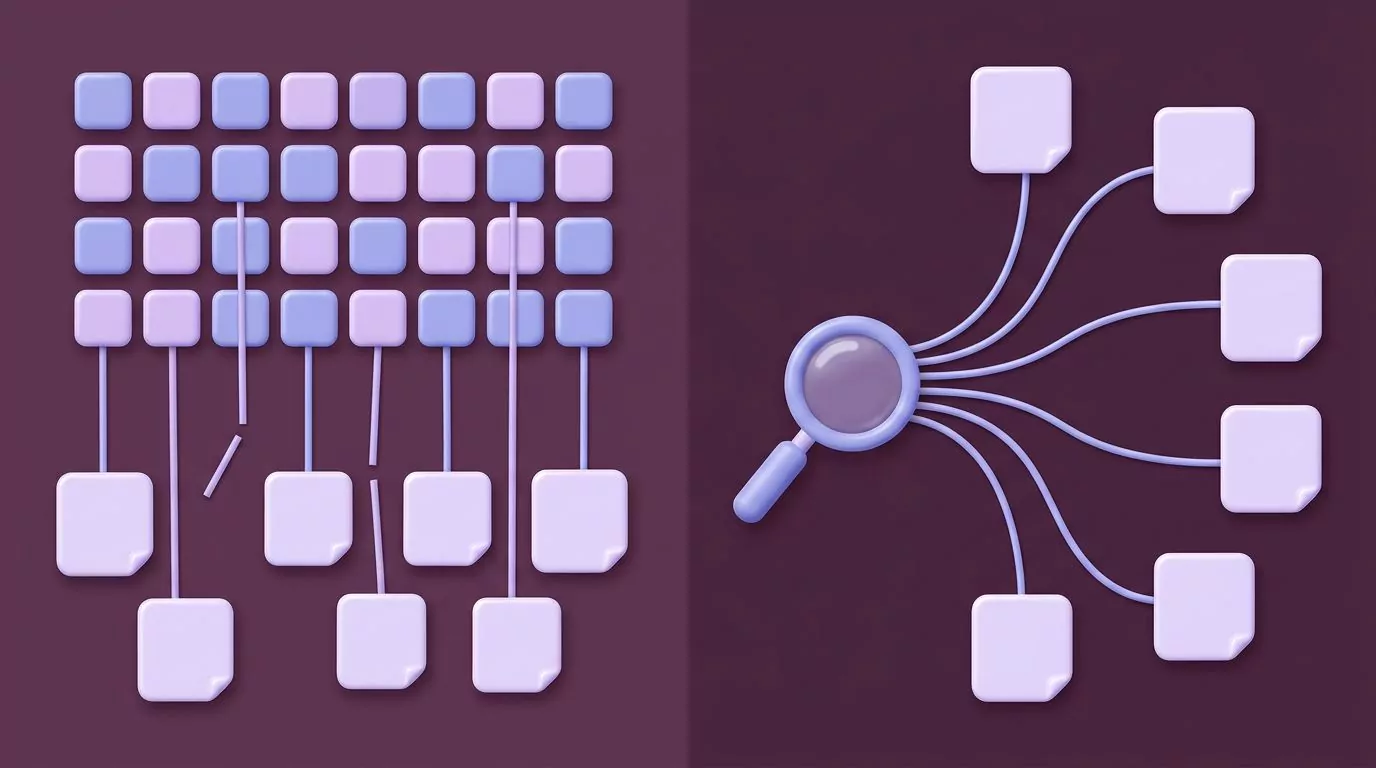
The mechanism is neat. You reserve two pages at the front for the index. On them you write every letter of the alphabet, and beside each letter the five vowels.
When you enter a passage, you give it a head word: the one important word that says what it is about. Then you look at that word's first letter, and the first vowel that follows that letter.
The head word Epistle starts with E, and the first vowel after the E is an I. So it goes under Ei, and you write the page number there. Later, anything else you filed under Ei is sitting in the same short list.
For a paper book in 1706, that is close to the best possible design. It gives you a compact index that never needs re-sorting, on a fixed two pages, forever.
What the index asks of you
Read the method again and count the jobs it hands you. There are three, and each one has to happen every time.
- Choose a head word at the moment of writing. You must decide what the passage is about before you know what you will want it for.
- Update the index immediately. Skip it once and the entry is invisible. Skip it for a month and the index is a lie.
- Remember the head word later. Retrieval only works if future you guesses the same word past you picked.
That third job is the one that quietly breaks everything. Your head words are guesses about a reader you have not met yet.
You file a passage about compound interest under Money. Two years later you go looking for it while writing about patience. It is right there under M, and you will never find it, because you are not thinking about money.
This is not a failure of discipline either. It is a real limit of any system where you have to name a thing before you know why it matters.
Phrase based retrieval: find it by half remembering it
Here is the thing nobody says out loud. You almost never remember the category. You remember the words.
You remember it said something about a river, or that it used the phrase "quiet desperation", or that the author called ambition a kind of debt. Fragments of the text itself survive in memory far better than any label you attached to it.
Full text search turns that fragment into the entry. You type the half remembered phrase and the passage comes back, whether or not you ever titled it, categorized it, or indexed it.
This flips the work. Locke's method asks you to do the filing on the way in, every time, for every entry. Phrase search asks you to do nothing on the way in, and a little guessing on the way out.
Guessing on the way out is cheaper, because you only pay it for the handful of entries you actually go looking for. You do not pay it four hundred times for entries you never touch again.
This is why a digital commonplace book can be genuinely better than a paper one, and it is the only respect in which that is clearly true. Not prettier. Not more thoughtful. Just findable.
It is also the reason capture and search belong together. VoiceSnap Pro is built around exactly that pairing: you dictate into whatever holds your notes, and every dictation is also saved to a notes library you can search by any phrase from the text. Notes group by day and by the app you dictated into, so "the thing I put in my journal file last Tuesday" is a real way to find something.
Two honest notes on that. It is the capture and search layer, not the notebook itself, so your commonplace book still lives wherever you want it to live. And the audio is transcribed and then discarded, so there is no recording of you reading the passage, only the text.
What to actually put in a commonplace book
Most people put in quotes and stop there. Quotes are the least valuable thing in the book.
A quote you copied and never thought about is a bookmark. Here is what makes the collection yours.
- The passage itself. Copy it accurately and note the author and the book. Future you will want to quote it without hunting for the source.
- Your reaction to it. One or two sentences on why it landed. This is the part that matters most and gets written down least.
- The argument you disagreed with. Keep the thing that annoyed you and one line on why. Disagreements age into ideas better than agreements do.
- The sentence you want to steal the rhythm of. Not for the content. For how it moves.
- The fact you keep having to look up. Numbers, dates, definitions. Small, but it saves a search every time.
- Things that are not from books. A line from a podcast, something a colleague said in a meeting, a good sentence from an email.
The second item is the one to fight for. Your reaction is the only part of the entry nobody else could have written.
It is also the part that never gets written, and the reason is mechanical. The passage is already on the page in front of you, so copying it is a known job with a known end. Your reaction has to be composed from nothing, and composing costs more than copying.
So it gets postponed, and postponed means never. This is the strongest argument for speaking your entries rather than typing them. Talking through a half formed reaction is easy, and writing one out is work.
Here is what a full entry looks like in practice, as a small example.
"The years teach much which the days never know." Ralph Waldo Emerson, Experience.
My reaction: this is an argument for keeping this book at all. On any given day nothing here looks important. The pattern only shows up when you read a year of entries at once.
Notice that the reaction is longer than the quote, and worth more.
Most commonplace book examples online show only the quote half, which is why they look so lifeless. Here is the same shape applied to something you disagreed with.
"Do what you love and the money will follow." Heard on a podcast, speaker not named.
My reaction: this is survivor logic. It gets said by people for whom it happened to work, and it quietly blames everyone it did not work for. Keep as an example of advice that cannot be tested.
That entry is worth more than a dozen agreeable quotes. If you want a commonplace book template, that is the whole template: passage, source, reaction. Three lines and no boxes to fill in.
Paper, plain text, or an app: an honest comparison
There is no correct answer here, and anyone who tells you otherwise is selling a notebook. There are only trade offs, so here they are side by side.
| What matters | Paper notebook | Plain text files | A notes app |
|---|---|---|---|
| Capture speed | Slow. Roughly 20 words a minute by hand. | As fast as you type, or faster if you dictate. | Fast, if capture is one keystroke away. |
| Cost of copying a passage in | High. Every word is written out. | Free from an ebook, high from paper. | Low to medium, depending on how text gets in. |
| Finding a phrase later | None. You read pages until you spot it. | Good. Any search tool on your computer works. | Usually the best of the three. |
| Portability | Excellent for one volume, poor by volume four. | Excellent. Files go anywhere. | Good on whatever devices it supports. |
| Getting your text back out | Retype it or photograph it. | Already out. The files are the format. | Only if it exports. Check before you commit. |
| If the tool dies | Nothing shuts down. Fire and water are the risks. | Text outlives the editor that made it. | The real risk. Export early and often. |
Read the bottom two rows again. They are the ones people ignore when choosing, and the ones that decide whether a collection survives a decade.
A reasonable hybrid: keep paper for the reading you do away from a desk, and keep the searchable copy as the real archive. The paper book is where you notice things. The digital one is where you find them.
Keeping it portable: export as plain text or Markdown
Say the habit works. Five years in, you have two thousand entries and it is the most valuable file you own.
Now ask the uncomfortable question. Can you get all of it out, right now, in one action, into a format you can read without that app?

If the answer is no, you do not own a commonplace book. You are renting one, and the landlord can raise the rent or close the building.
This is not a hypothetical worry. Note apps get acquired, change their pricing, drop platforms, and shut down. People have lost years of notes to all four.
Why plain text and Markdown are the right targets
Plain text is the only format with a genuinely long track record. A text file written in 1990 opens today in anything, and needs no company to still exist.
Markdown is plain text with a few marks for headings, bold, and lists. It stays readable if nothing understands it, and turns into clean formatting if something does.
Between them they cover both futures. Your collection stays legible as a raw file, and it drops cleanly into a document, a manuscript, or another notes tool when you want it to.
What to check before you commit to any tool
- Is there an export at all? Find the button before you put five years into the app, not after.
- Does it export everything? Some tools export one note at a time, which is not an export.
- Is the output readable on its own? Text and Markdown pass. A proprietary database file does not.
- Does it keep the dates? When you wrote something is part of the entry.
- Have you actually run it once? Do it this month, then look at the files.
That last one is the whole test. An export you have never run is a claim, not a feature.
For what it is worth, this is the bar any capture tool should clear. The notes library described earlier exports a single note, one day, or the whole collection as plain text or Markdown, so a pile of dictated passages can move into a document later. That is an export and not a live connection, which is the honest way to read any such feature.
A weekly review that takes five minutes
Capture and search do most of the work. A short weekly pass does the rest, and five minutes is genuinely enough.
The point is not to tidy. It is to re-read this week's entries once while you still remember them.

- Skim what you captured. Read the week's entries straight through. No editing yet, just read.
- Add a reaction where it is missing. Find the entries that are bare quotes and give each one a sentence. This is the highest value minute of the week.
- Connect two entries. Find one pair that belongs together and write a line saying why. Connections are where this habit stops being storage and starts being thinking.
- Delete what did not survive the week. Some passages looked profound on Tuesday and look ordinary now. Let them go.
- Write one sentence of your own. One line, in your words, about anything you read. Over a year that is a few hundred original sentences you would not otherwise have written.
Step four surprises people. Deleting feels like waste, and it is the opposite: a collection where everything was kept is one where nothing was chosen.
Notice what is not on the list. There is no filing step, no index to update, and no categories to maintain. That work has been replaced by search, which is the entire argument of this guide.
If you want a monthly version, add one job to it. Read a random month from last year and see which entries still hold up.
Starting one this week
Most advice on how to keep a commonplace book is about the writing. Almost none of it is about the finding, and the finding is what decides whether you still have the habit in a year.
You do not need a system. You need somewhere to put things and a way to find them again.
Pick one file or one notebook and put everything in it. One place beats a clever structure, every time, because a clever structure gives you a decision to make at the exact moment you were about to lose the thought.
Then set your bar low. Five entries in a week is a real commonplace book. Zero perfect entries is not.
If the copying step is what has stopped you before, speaking the passage instead of typing it removes most of that cost. VoiceSnap Pro is in early access at $39 one time before launch, and you can read Ryan Holiday's account of the practice while you decide whether the habit is for you at all. Either way, the passage you liked yesterday is still worth writing down today.
Frequently Asked Questions
What is a commonplace book?
A commonplace book is a personal notebook where you collect passages from what you read, along with your own notes on them. It is not a diary of your day. It is a running archive of other people's best lines and your reactions to them, kept so you can use them later.
What is the difference between a commonplace book and a journal?
A journal is about you, and it runs in date order. A commonplace book is about what you encountered, and it is organized by topic or by search rather than by day. The commonplace book vs journal question usually resolves into keeping both, since they answer different needs.
Should a commonplace book be paper or digital?
Paper is better for thinking, because writing by hand slows you down. Digital is better for finding, because you can search the text years later. Many people read with paper nearby and keep the searchable copy as the archive, which gets you both.
How do you organize a commonplace book without an index?
The question of how to organize a commonplace book has a short modern answer: let search do the filing. Keep everything in one searchable place and find entries by typing a phrase you half remember from the text itself. This works better than categories because you remember the words a passage used long after you have forgotten what heading you filed it under.
What should you write in a commonplace book?
Write the passage, the source, and your reaction to it. The reaction is the part that makes the collection yours, so add at least one line even when you are in a hurry. Beyond quotes, good commonplace book ideas include arguments you disagreed with, sentences whose rhythm you admire, and facts you keep looking up.